Innovative Educational Leadership and Impact
Indian Teacher Who Created Hundreds of Learning Centers Wins $1 Million Global Teacher Prize
Indian educator Rouble Nagi has won the $1 million Global Teacher Prize in recognition of her work establishing more than 800 learning centers and using art to promote education in underserved communities across India.

Transformative Educational Outreach
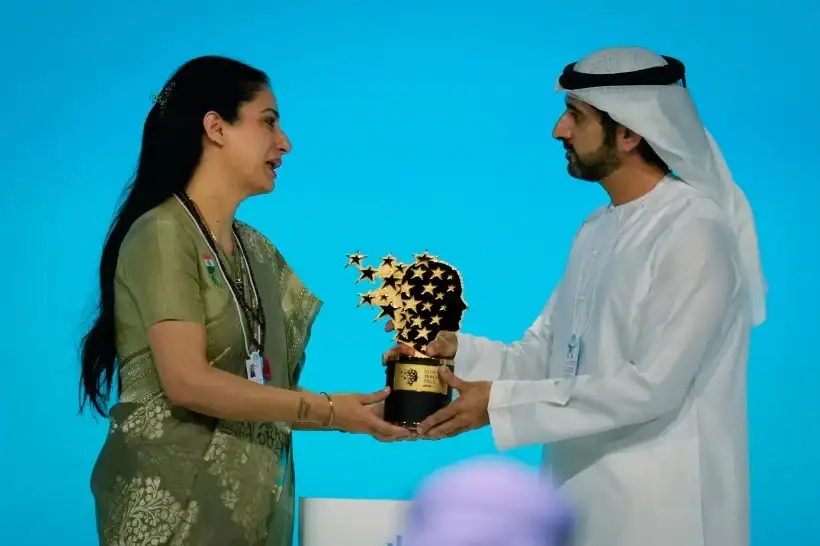
Rouble Nagi, an Indian teacher and activist, has made an indelible mark on education across India, winning the prestigious $1 million Global Teacher Prize at the World Governments Summit in Dubai. Through her Rouble Nagi Art Foundation, she has established over 800 learning centers in underserved areas of the country, making education accessible to children who might otherwise be excluded from the formal education system. These centers serve not only children who have never attended school but also provide additional support for those already enrolled in formal education. Nagi's dedication to expanding access to education has helped thousands of children across India acquire the knowledge and skills they need to succeed in life. Her work goes beyond simply creating physical spaces for learning; it is rooted in the belief that every child deserves an opportunity to learn, regardless of their socio-economic background. The centers are equipped with tools, resources, and dedicated educators who strive to create an environment where children can thrive. The impact of Nagi's work is not limited to the children directly served by these centers; it also has a ripple effect on entire communities, helping to break the cycle of poverty and create opportunities for the next generation. By addressing the educational needs of marginalized communities, Nagi is contributing to the broader goal of educational equity in India, where access to quality education remains a challenge for many.
Learning Through Art and Murals
Rouble Nagi’s approach to education is innovative and deeply creative, combining the power of art with structured learning to engage children in ways that traditional classroom environments may not. Beyond the creation of learning hubs, Nagi has painted educational murals in slum communities across India, transforming public spaces into vibrant learning environments. These murals cover a wide range of subjects, from literacy and science to mathematics and history, and are designed to engage children visually, making learning an interactive experience. The murals serve as an educational tool that children can connect with and reflect on every day. The visual nature of these murals helps to reinforce the importance of learning while also making it accessible for children who may struggle with traditional forms of education. In a country where a significant number of children are denied access to formal schooling, Nagi’s method of teaching through art offers an alternative means of fostering curiosity and creativity. Her murals are not just about aesthetics; they are a form of storytelling that brings complex concepts to life, especially for those living in impoverished conditions. For children in underserved communities, these murals represent a window into the world of knowledge, offering them an opportunity to learn in a way that resonates with them personally. Nagi’s blend of art and education also serves as an inspiration to other educators, highlighting the importance of creativity and adaptability in teaching.
At the World Governments Summit in Dubai, Rouble Nagi was awarded the Global Teacher Prize, one of the most prestigious honors in the field of education, recognizing her exceptional work in transforming the lives of children in India. This international recognition celebrates educators who have made a lasting impact on their communities and the lives of their students. The award was presented by the Varkey Foundation, an organization dedicated to supporting and celebrating outstanding educators. Nagi’s recognition as the 10th recipient of the Global Teacher Prize underscores the global importance of her work and highlights the potential for education to drive social change. The ceremony in Dubai brought together world leaders, policymakers, and education experts to celebrate the contributions of educators like Nagi, who go beyond the traditional roles of teaching to create lasting, positive change in society. The Varkey Foundation’s decision to honor Nagi is a testament to the power of individual educators to spark transformation and improve access to education for those who need it most. The award also draws attention to the broader issue of educational inequality, particularly in developing countries, where millions of children continue to face barriers to education.
Rouble Nagi has announced plans to use the $1 million prize money from the Global Teacher Prize to establish a vocational training institute in India. This new initiative aims to provide free vocational training to young people, offering them practical and employable skills that will help them find sustainable jobs and improve their livelihoods. Nagi’s vision is to create pathways for economic empowerment in underserved communities, enabling young people to break free from cycles of poverty. By expanding the focus of her educational outreach to include vocational training, Nagi is addressing an important gap in the education system. While foundational education is critical, vocational skills are equally important for preparing young people for the workforce. The vocational institute will offer a range of training programs tailored to the needs of the local job market, focusing on skills that are in high demand, such as technology, manufacturing, and healthcare. By equipping young people with these skills, Nagi hopes to provide them with the tools they need to succeed in the modern economy. The institute will also serve as a model for other regions, demonstrating the importance of expanding education beyond the classroom and into the realm of practical, real-world skills.
Nagi’s work has garnered widespread recognition from educational leaders and organizations across the globe. The Varkey Foundation, which awarded her the Global Teacher Prize, described her as a teacher who embodies the very best qualities of the profession: courage, compassion, and an unwavering belief in the potential of every child. UNESCO Assistant Director-General for Education, Stefania Giannini, also praised Nagi’s efforts, calling her a role model for educators worldwide. Giannini emphasized the critical role that educators play in shaping the future of society and underscored the importance of innovation in teaching practices. Nagi’s creative approach to teaching, which combines art with education, has inspired educators around the world to rethink how they engage with their students. Her work is a reminder of the transformative power of education and the vital role that teachers play in addressing global challenges such as poverty, inequality, and social injustice. The recognition Nagi has received is not only a celebration of her individual achievements but also a call to action for governments, organizations, and educators to invest more in innovative approaches to education, particularly in underserved communities where access to quality education is limited.
Nagi’s work extends far beyond the establishment of learning centers and murals. She has become a powerful advocate for the importance of education as a tool for social change. Through her foundation, she has worked to ensure that education is accessible to all, particularly those who have been historically marginalized. Nagi’s efforts to improve education for underserved communities are part of a broader movement to create educational equity in India, where millions of children continue to lack access to quality schooling. By focusing on creative and innovative methods of teaching, Nagi is making learning more engaging and meaningful for children who might otherwise be overlooked by traditional education systems. Her work has also brought attention to the need for greater investment in education in India and other developing countries, where educational disparities remain a major challenge. Nagi’s influence as an educator and activist has reached far beyond her immediate community, inspiring educators, policymakers, and social leaders to think critically about the role of education in addressing global inequalities.
In addition to her educational achievements, Nagi’s recognition has brought attention to the broader issue of women’s empowerment in education. As a woman leading a transformative educational initiative in a country where gender inequality remains a challenge, Nagi serves as a role model for girls and women everywhere. Her success as an educator and social entrepreneur challenges the traditional norms that often limit women’s opportunities, particularly in rural areas. Nagi’s leadership in the field of education is proof that women can drive change and make significant contributions to society. Through her work, she is not only empowering young people with education but also empowering women by showing them the value of their contributions and the importance of their leadership in creating social change. The recognition she has received underscores the growing recognition of the importance of women’s voices in education and highlights the role of women as leaders in shaping the future of the world’s most vulnerable populations.
Rouble Nagi’s achievements and recognition through the Global Teacher Prize are a testament to the power of dedicated educators who go above and beyond to make a difference in the lives of their students. Her impact is not just measured by the number of learning centers she has established or the murals she has painted, but by the lasting change she has brought to the communities she serves. Nagi’s work represents a new model of education that is inclusive, creative, and focused on empowering individuals to improve their own lives. The $1 million prize money will enable her to further expand her work, creating new opportunities for young people in India and beyond. Her story is a reminder that educators are some of the most important agents of change in society, and that their contributions are fundamental to building a better future for all. Nagi’s recognition is not only a celebration of her personal achievements but also a call to action for governments, communities, and individuals to invest more in education and to support those who are working tirelessly to create a more equitable world.
Leave a Comment
Your email address will not be published. Required fields are marked *