Stock Market
S&P 500 and Nasdaq Hit Record Highs on Nvidia AI Rally
Wall Street indexes climbed as Nvidia and AI stocks drove a strong market rally, pushing the S&P 500 and Nasdaq to new record highs.

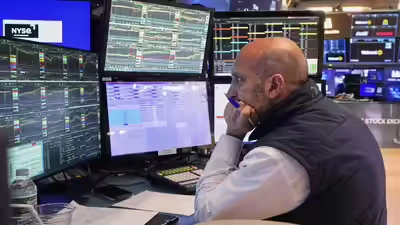
Markets Close at All-Time Highs — Again
Wall Street had another strong Thursday. The S&P 500 closed at 7,502.04, up 0.78% on the day. The Nasdaq Composite finished at 26,635.22, gaining 0.88%. The Dow Jones Industrial Average added 0.75% to close at 50,063.45 — crossing back above 50,000 for the first time since February. Both the S&P 500 and the Nasdaq ended the session at record closing levels, continuing a run that has now stretched across several weeks. The rally has been powered almost entirely by one theme: artificial intelligence. Chipmakers, networking companies, and AI infrastructure firms have been leading the charge, and Thursday was no different. The market has now logged six straight weeks of gains — the longest winning streak since October 2024. Earnings season gave it another push. Corporate results have broadly come in stronger than expected, with 83% of S&P 500 companies that reported first-quarter results beating analyst estimates. That kind of beat rate does not happen in a struggling economy, and investors are responding accordingly.
Nvidia Adds $5.7 Trillion Market Cap as H200 China Deal Surfaces
Nvidia was the day's single biggest story, and not just because its stock rose nearly 4%. The move was triggered by news that U.S. authorities cleared roughly 10 Chinese firms — reportedly including Alibaba, Tencent, ByteDance, and JD.com — to purchase Nvidia's H200 AI chip, its second-most-powerful accelerator. No shipments have happened yet, but the clearance itself was enough. Investors read it as a sign that the U.S.-China relationship may be thawing on the technology front, at least around AI hardware. The timing was not coincidental. Nvidia CEO Jensen Huang was part of a delegation of American business leaders who joined President Trump in Beijing for a two-day summit with Chinese President Xi Jinping. Xi reportedly told the assembled executives that their companies could be deeply involved in China's reform and opening up, and that China's door will only open wider. That kind of political signal moved money fast. Nvidia's market cap reached $5.7 trillion on Thursday — a number that a year ago would have seemed impossible.
Cisco Earnings Set Off a Second Wave of Buying
If Nvidia was the headline, Cisco was the confirmation. The networking giant posted record quarterly revenue of $15.84 billion and adjusted earnings per share of $1.06, both beating expectations by a wide margin. More importantly, Cisco blew up its own AI orders forecast. The company had previously guided for $5 billion in AI infrastructure orders for the fiscal year. Thursday morning, it revised that figure to $9 billion. Year-to-date AI orders have already reached $5.3 billion, with third-quarter orders from hyperscale cloud customers climbing to $1.9 billion — up from $600 million in the same period a year ago. Cisco shares surged more than 14% to an all-time high. The company also announced it would cut nearly 4,000 jobs as part of a restructuring focused on what CEO Chuck Robbins called the AI era. The market took both pieces of news positively. Broadcom caught a lift too, rising around 5% to a 52-week high on the back of Cisco's AI spending numbers. The sector read those figures as a real-world demand signal — not a projection, but actual orders from hyperscalers building out AI infrastructure right now.
Cerebras Goes Public — and Nearly Doubles on Its First Day
Thursday also brought the biggest tech IPO of 2026. Cerebras Systems, an AI chipmaker that has positioned itself as a direct competitor to Nvidia, priced its shares at $185 and opened on the Nasdaq under the ticker CBRS at $350. At one point during the session the stock hit $385, triggering a circuit breaker. It closed up 68%, valuing the company at roughly $95 billion and briefly pushing that figure above $100 billion intraday. The IPO raised $5.55 billion — making it the largest U.S. tech listing since Arm in 2023, and the order book was more than 20 times oversubscribed. Cerebras makes what it calls the largest commercial chip ever produced, a wafer-scale processor roughly the size of an iPad that integrates hundreds of thousands of compute cores on a single piece of silicon. The company reported revenue of $510 million last year, up 76%, with net income of $88 million — a sharp swing from a loss of $481 million the year before. Amazon and OpenAI are among its customers. The debut added another layer of excitement to a day that was already running hot on AI sentiment.
US-China Summit Adds a Geopolitical Tailwind
Beyond the earnings and IPO headlines, markets got a geopolitical lift Thursday from the Trump-Xi summit in Beijing. The two leaders reportedly agreed that the Strait of Hormuz must remain a free waterway and that Iran should not be able to impose payments on shipping traffic through the route. U.S. Treasury Secretary Scott Bessent told CNBC that China would use its influence with Iran to help reopen the strait. China is the world's largest crude oil importer, with more than half of its supply coming from the Middle East — so it has real economic incentive to push for a resolution. Investors heard that and responded. The news helped calm some of the oil-driven inflation anxiety that had been building since March. Technology stocks, which are particularly sensitive to rate expectations, got a secondary boost because a faster resolution to the Middle East conflict means less oil pressure, which means less inflation risk, which means the Fed is less likely to raise rates.
Retail Sales and Jobless Claims Keep the Macro Backdrop Solid
The day's economic data added to the positive tone without stealing the spotlight. April retail sales rose 0.5%, in line with estimates, showing consumers are still spending even with gasoline above $4.50 a gallon. The figure came in below March's 1.6% gain, which reflected some post-war-shock spending surge, but the trend is still healthy. Weekly initial jobless claims rose by 12,000 to 211,000 — slightly above the 205,000 forecast, but not alarming. A labor market that stays near 210,000 weekly claims is still performing well by historical standards. The Atlanta Fed's GDPNow tracker was pointing toward 3.7% economic growth for the second quarter, though on a limited set of early data. Put it all together and the macro backdrop on Thursday told a consistent story: the economy is running, earnings are beating, AI spending is real, and diplomacy is opening doors. That combination is why the market keeps going up. The harder question — how long this can last — is one Wall Street will have to wrestle with soon enough.
Leave a Comment
Your email address will not be published. Required fields are marked *